
- This brewing glossary defines the terms recipes, kit instructions and forum posts assume you know, from ABV to zymurgy.
- Numbers you will see most: OG and FG (gravity), ABV (strength), IBU (bitterness), SRM or EBC (color) and volumes of CO2 (carbonation).
- Process words: mash, sparge, boil, whirlpool, pitch, krausen, diacetyl rest, cold crash, lagering, rack, prime, keg.
- Wine, cider, mead and kombucha terms are included, with links to the guide for each.
- Each entry links to the guide or calculator that goes deeper.
This brewing glossary is a plain-English A–Z of the words you meet in homebrew recipes, kit instructions, competition scoresheets and the guides on this site. Definitions are short and practical; where a number or a safety rule matters, it comes from the same published sources the guides use (BJCP, AHA, BYO, maker data sheets and federal rules).
Terms are grouped by letter. Abbreviations have their own table near the top, and a quick “numbers in action” section shows what OG, FG, IBU and SRM look like for real styles.
Abbreviations at a glance
Common homebrew abbreviations
| Abbreviation | Stands for | Where you see it |
|---|---|---|
| ABV | Alcohol by volume | Strength of the finished beer, wine or cider |
| AIO | All-in-one (electric brewing system) | Anvil Foundry, BrewZilla, Grainfather |
| BIAB | Brew in a bag | One-vessel all-grain method |
| DME / LME | Dry / liquid malt extract | Extract brewing |
| FG / OG | Final / original gravity | Hydrometer readings |
| IBU | International bitterness units | Bitterness, often by Tinseth’s formula |
| SRM / EBC | Standard Reference Method / European Brewery Convention | Beer color (EBC ≈ SRM × 1.97) |
| °P / °Bx | Degrees Plato / Brix | Sugar content; refractometers read Brix |
| psi / vol | Pounds per square inch / volumes of CO2 | Kegging and carbonation |
| HLT / MLT / BK | Hot liquor tank / mash-lauter tun / boil kettle | Three-vessel systems |
| K-meta | Potassium metabisulfite | Wine, cider and mead sulfite |
| TA | Titratable acidity | Wine and cider acid testing |
| GFCI | Ground-fault circuit interrupter | Electric brewing safety |
| TTB | Alcohol and Tobacco Tax and Trade Bureau | Federal homebrew and labeling rules |
Source: BJCP; AHA; site formula notes
Numbers in action
Here is what the core numbers look like for three common styles, straight from the BJCP 2021 guidelines. OG and FG are specific gravities, IBU is bitterness, SRM is color and ABV is strength.
Beer styles by the numbers (BJCP 2021 vital statistics)
| Style | OG | FG | IBU | Color (SRM) | ABV |
|---|---|---|---|---|---|
| 5D German Pils | 1.044–1.050 | 1.008–1.013 | 22–40 | 2–4 | 4.4–5.2% |
| 18B American Pale Ale | 1.045–1.060 | 1.010–1.015 | 30–50 | 5–10 | 4.5–6.2% |
| 15B Irish Stout | 1.036–1.044 | 1.007–1.011 | 25–45 | 25–40 | 3.8–5.0% |
| 21A American IPA | 1.056–1.070 | 1.008–1.014 | 40–70 | 6–14 | 5.5–7.5% |
Source: BJCP 2021 Beer Style Guidelines. Ranges are for judging; your recipe can sit anywhere inside them. Color swatches are an on-screen approximation.
Turn your own readings into strength with the ABV calculator, estimate bitterness with the IBU calculator and color with the SRM color calculator.
A–C
- ABV (alcohol by volume): the percentage of alcohol in the finished drink. The standard estimate is (OG − FG) × 131.25. See ABV calculator.
- Acid blend: a mix of tartaric, malic and citric acids added to low-acid fruit wines and meads.
- Adjunct: any fermentable that is not malted barley: corn, rice, oats, wheat, sugar, honey.
- Aeration / oxygenation: adding oxygen to cooled wort so yeast can grow; shaking, an aeration stone or pure O2. See wort aeration.
- Airlock: a water- or sanitizer-filled valve that lets CO2 out of a fermenter and keeps air and insects out.
- Alpha acids (AA%): the bittering compounds in hops, listed as a percentage on the package and used in IBU math.
- Attenuation: how much of the sugar the yeast ferments, as a percentage. Fermentis lists US-05 at 78–82% apparent attenuation.
- Autolysis: yeast cells breaking down after long contact with finished beer, giving meaty or rubbery flavors.
- Backsweetening: adding sugar, juice or honey to finished wine, cider or mead; stabilize first. See stabilize and backsweeten.
- Ball lock / pin lock: the two post styles on corny kegs; disconnects are not interchangeable.
- Beer gun: a filler that purges a bottle with CO2 and fills it from a keg. See bottling from a keg.
- Beerstone: mineral scale in lines and kegs, removed with an acid cleaner. See draft line cleaning.
- Bentonite: a clay fining used in wine and mead to remove protein haze.
- BIAB (brew in a bag): all-grain brewing with the grain in a mesh bag in the kettle, lifted out after the mash.
- BJCP: Beer Judge Certification Program, publisher of the beer (2021), cider (2025) and mead (2026) style guidelines used in competitions.
- Blow-off tube: a wide tube from the fermenter into a jar of sanitizer, used instead of an airlock when foam is vigorous.
- Boil-off: water lost as steam during the boil, usually measured per hour. See dilution and boil-off calculator.
- Bottle bomb: a bottle that bursts from too much pressure, usually from bottling before fermentation finished or overpriming.
- Bottle conditioning: carbonating beer in the bottle with priming sugar and live yeast. See how to bottle homebrew.
- Braggot: a mead made with malt (BJCP M4A).
- Brix (°Bx): sugar percentage by weight, read by refractometers; close to degrees Plato.
- Campden tablet: a pressed tablet of potassium or sodium metabisulfite; used to sulfite wine and cider and to remove chloramine from brewing water.
- Carbonation (volumes of CO2): how much CO2 is dissolved, expressed as volumes of gas per volume of beer. See carbonation explained.
- Carboy: a narrow-necked glass or PET fermenter, usually 1–6.5 gal.
- Chill haze: cloudiness that appears only when beer is cold, from proteins binding with polyphenols.
- Chloramine: a water disinfectant that causes medicinal flavors; Campden tablets neutralize it.
- Clarity Ferm: a proline-specific enzyme sold to reduce haze; used for gluten-reduced beer, which is not celiac-safe. See gluten-reduced homebrewing.
- Cold break: proteins that clump and drop out when wort is chilled quickly.
- Cold crash: chilling a finished beer near freezing for a day or more so yeast and haze settle.
- Conditioning: the period after fermentation when beer matures and carbonates.
- Corny keg: a 5 gal (19 L) stainless soda keg used for homebrew, with ball or pin lock posts.
- Counter-pressure filler: a device that fills bottles from a keg under balanced pressure to keep carbonation.
- Cyser: mead made with apple juice (BJCP M2A).
D–H
- DAP (diammonium phosphate): an inorganic nitrogen yeast nutrient, common in wine, mead and seltzer; not for the yeast rehydration water.
- Degassing: stirring dissolved CO2 out of young wine, essential before fining kit wines. See wine from a kit.
- Diacetyl: a buttery or butterscotch off-flavor; a diacetyl rest (warming beer near the end of fermentation) lets yeast clean it up. See lager brewing.
- Dextrins: unfermentable carbohydrates that add body; more of them come from warmer mashes.
- DME / LME: dry and liquid malt extract, the base of extract brewing.
- DMS (dimethyl sulfide): a cooked-corn off-flavor, reduced by a vigorous uncovered boil and quick chilling.
- Dry hopping: adding hops after the boil, usually in the fermenter, for aroma.
- EBC: European color scale, roughly SRM × 1.97.
- Efficiency (mash or brewhouse): how much of the grain’s potential sugar ends up in your wort.
- Esters: fruity aroma compounds from yeast; more at warmer fermentation temperatures.
- Extract brewing: brewing with malt extract instead of mashing grain. See how to brew beer at home.
- Fermaid O / K: Lallemand yeast nutrients: O is organic nitrogen without DAP; K is a blend.
- Fermentation chamber: a fridge or freezer on a temperature controller used to hold fermentation temperature.
- FG (final gravity): the specific gravity when fermentation is finished; stable over two or three readings.
- Finings: additives that clear beer or wine by binding haze particles: Whirlfloc, gelatin, isinglass, silica, kieselsol and chitosan. See finings and clarifiers.
- Flocculation: how readily yeast clumps and settles after fermentation.
- Force carbonation: carbonating beer in a keg with CO2 pressure. See keg carbonation chart.
- Go-Ferm: a Lallemand rehydration nutrient added to the water when rehydrating wine yeast.
- Gravity (specific gravity, SG): the density of wort or wine compared with water (1.000); sugar raises it, fermentation lowers it.
- Grist: the milled grain for a mash.
- Gypsum: calcium sulfate, a brewing salt that adds calcium and sulfate. See water chemistry.
- Headspace: the air gap above liquid in a fermenter, keg or bottle.
- Hop spider: a mesh basket that holds hops in the kettle.
- Hot break: proteins that coagulate when wort first boils, often with a foamy surge.
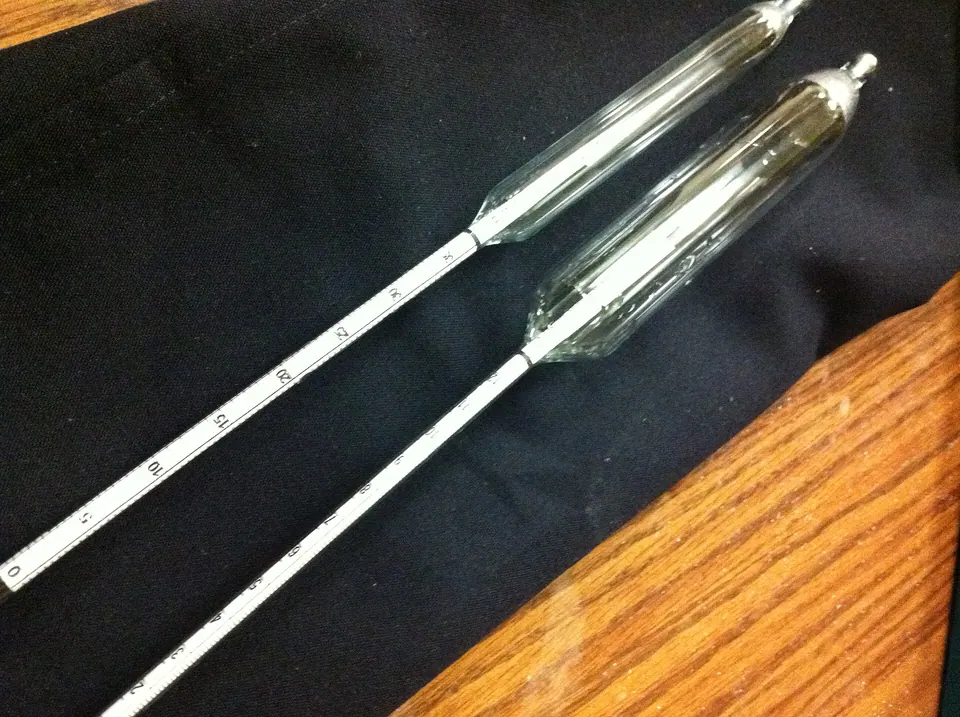
- Hydrometer: a floating instrument that measures specific gravity, calibrated at 60°F or 68°F. See how to use a hydrometer.
I–M
- IBU (international bitterness units): a measure of bitterness; homebrewers estimate it with Tinseth’s formula. See IBU calculator.
- Immersion chiller: a coil of copper or stainless tubing placed in the kettle with cold water running through it.
- Irish moss: a seaweed-based kettle fining, added in the last 15 minutes of the boil (BYO).
- Isinglass: a fining made from fish swim bladders; not vegan.
- Keezer: a chest freezer converted into a kegerator with a collar and a temperature controller. See kegerator and keezer guide.
- Kegerator: a fridge built or converted to hold and dispense kegs.
- Kieselsol and chitosan: a two-part fining; chitosan comes from shellfish, an allergen to flag.
- Krausen: the thick foam on top of actively fermenting beer.
- Kveik: Norwegian farmhouse yeast that ferments cleanly at high temperatures; Lallemand lists Voss at 25–40°C. See kveik guide.
- Lag phase: the hours between pitching yeast and visible fermentation.
- Lagering: cold conditioning near freezing for weeks after fermentation.
- Lauter: separating sweet wort from the grain after the mash.
- Lees: sediment of yeast and fruit solids at the bottom of wine, cider or mead.
- Malolactic fermentation (MLF): bacteria converting sharp malic acid to softer lactic acid in wine.
- Maltose-negative yeast: yeast that cannot ferment maltose, used for low-alcohol beer. See low-alcohol homebrewing.
- Mash: soaking milled grain in hot water so enzymes convert starch to sugar. See how to brew all-grain.
- Mash pH: the acidity of the mash, typically targeted in the low 5s. See mash pH.
- Mead: wine made from honey; categories in the BJCP 2026 mead guidelines. See how to make mead.
- Melomel: mead made with fruit (BJCP M2).
- Metheglin: mead made with spices or herbs (BJCP M3A).
- Methanol: a natural trace product of fruit pectin breakdown; normal fermentation does not make dangerous amounts. See methanol in homemade wine.
- Must: unfermented juice or honey water for wine, cider or mead (the wine equivalent of wort).
N–R
- NHC: the AHA’s National Homebrew Competition. See clubs and competitions.
- No-rinse sanitizer: a sanitizer such as Star San that does not need rinsing at label dilution.
- OG (original gravity): the specific gravity of wort or must before fermentation.
- Oxidation: staling from oxygen after fermentation: papery, sherry-like or dull hop flavors.
- Pectic enzyme: an enzyme that breaks down fruit pectin to prevent haze; it can slightly raise methanol, never lower it.
- Perry: cider made from pears (BJCP C4).
- Pitch / pitch rate: adding yeast to wort; pitch rate is how many cells per mL per °Plato. See pitch rate calculator.
- Plato (°P): sugar content by weight; about 259 − 259 ÷ SG.
- Plate chiller: a compact heat exchanger that chills wort as it flows through thin plates.
- Priming sugar: sugar added at bottling so yeast carbonates the beer. See priming sugar calculator.
- Pyment: mead made with grapes or grape juice (BJCP M2B).
- Racking: siphoning beer or wine off sediment into another vessel.
- Refractometer: a handheld instrument that reads sugar (Brix) from a few drops; needs a correction once alcohol is present.
- Rehydration: soaking dry yeast in water before pitching; optional for many beer yeasts per Fermentis and Lallemand. See rehydrate dry yeast.
- Residual alkalinity (RA): a measure of how much water resists mash acidity.
- Residual CO2: carbonation left in beer after fermentation, which depends on the warmest temperature it reached.
S–Z
- Sanitizing vs cleaning: cleaning removes soil; sanitizing kills microbes on a clean surface. See cleaning vs sanitizing.
- SCOBY: symbiotic culture of bacteria and yeast that ferments kombucha. See kombucha safety.
- Secondary: a second vessel for aging or clearing; optional for most beers.
- Session beer: a lower-alcohol beer meant for several servings, still alcoholic.
- Sorbate (potassium sorbate): a stabilizer that stops yeast reproducing; used with sulfite before backsweetening.
- Sparge: rinsing the grain bed with hot water to collect more sugar.
- Spunding valve: an adjustable pressure-relief valve that lets a fermenter or keg hold a set pressure. See pressure fermenting.
- SRM: beer color scale; Morey’s formula estimates it from grain color. See color calculator.
- Starter: a small batch of wort used to grow more yeast before brew day. See yeast starters.
- Strike water: the hot water added to grain to start the mash. See strike water calculator.
- Stuck fermentation: fermentation that stops before reaching the expected final gravity.
- Sulfites: sulfur compounds from Campden tablets or K-meta; commercial wine with 10 ppm or more must say “Contains sulfites” (TTB).
- Tannin: astringent compounds from grape skins, oak, tea or grain husks.
- Trub: the sediment of proteins, hop matter and yeast left in the kettle or fermenter.
- Whirlfloc: a tablet of Irish moss and carrageenan used as a kettle fining.
- Whirlpool: stirring hot wort after the boil so trub collects in a cone, often with an aroma hop addition.
- Wort: the sweet, unfermented liquid that becomes beer.
- Yeast nutrient: nitrogen, vitamins and minerals for yeast, essential for mead and seltzer.
- Zymurgy: the science of fermentation, and the name of the AHA’s magazine.
Reading a recipe, step by step
Recipes pack most of these terms into a few lines. Here is how to read one:
- Batch size and efficiency
The volume into the fermenter and, for all-grain, the mash efficiency the recipe assumes.
- Fermentables
Grains or extract by weight, with color in °L; these set OG and SRM.
- Mash
Temperature and time; warmer mashes make more dextrins and body.
- Hops
Variety, weight, alpha acid % and boil time; these set IBU.
- Yeast and fermentation
Strain, pitch rate and temperature schedule.
- Targets
OG, FG, ABV, IBU and SRM so you can check your batch against the plan.
- Packaging
Carbonation in volumes of CO2, for priming or kegging.
Log your own version in the brew-day log so the next brew is repeatable.
The instruments behind most of these numbers are a hydrometer (gravity), a refractometer (Brix on brew day), a thermometer and, for all-grain and kombucha, a pH meter. Browse them in hydrometers and meters, and start a first batch from your first brew day.
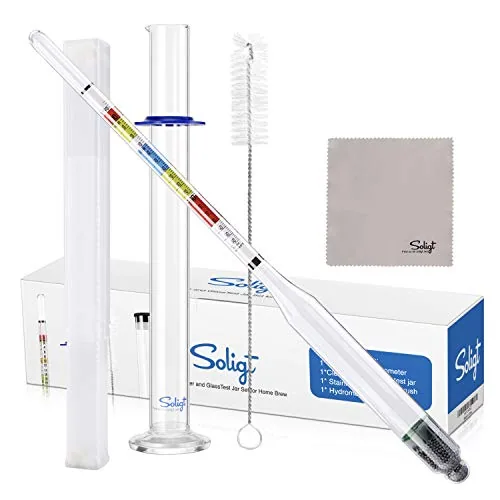
SOLIGT Triple Scale Hydrometer & Glass Test Jar Kit
- Range
- SG 0.990–1.170, Brix 0–35, potential ABV 0–20%
- Scale
- Triple (SG, Brix, potential alcohol)
Best for A complete first hydrometer kit
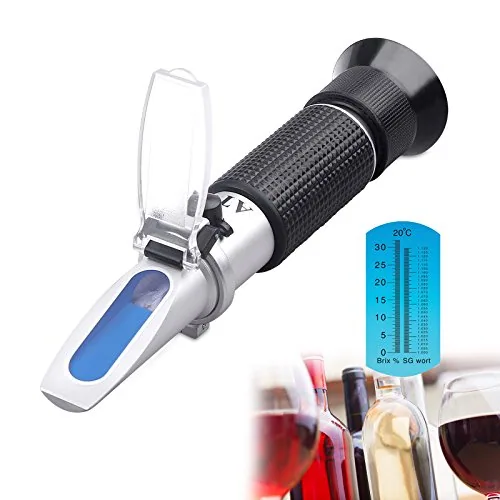
Tiaoyeer Brix/SG Refractometer with ATC
- Range
- Brix 0–32%, SG 1.000–1.130
- Accuracy
- ±0.2% Brix
- Scale
- Dual (Brix, SG)
Best for Quick wort gravity checks on brew day
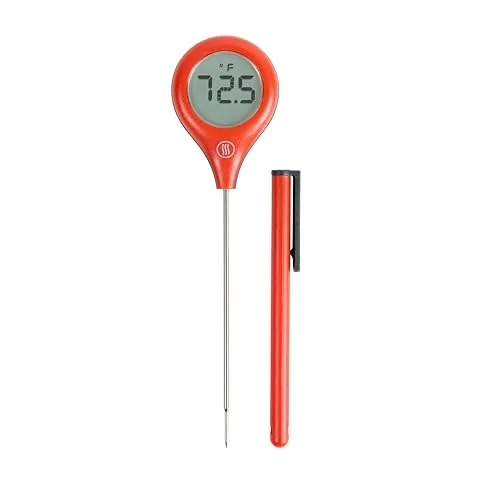
ThermoWorks ThermoPop 2 Instant-Read Thermometer
- Accuracy
- ±1°F (±0.5°C)
Best for An affordable first brewing thermometer
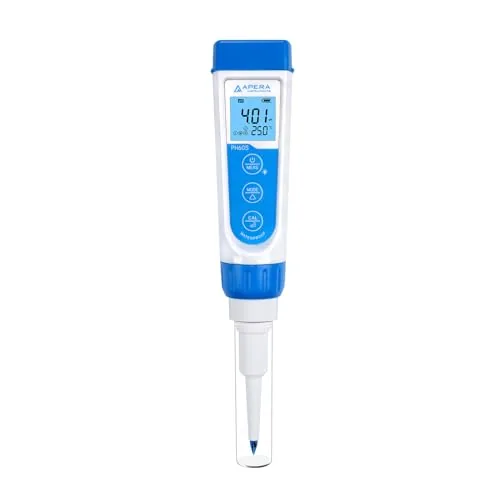
Apera PH60S Food pH Meter Kit (Spear Electrode)
- Range
- −2.00 to 16.00 pH
- Accuracy
- ±0.01 pH
- ATC
- Yes
Best for Kombucha and wine pH checks
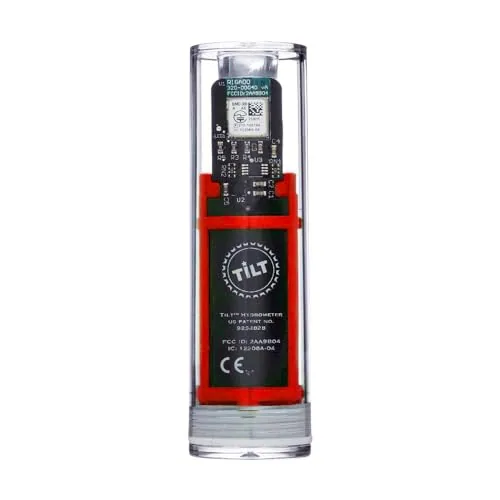
Tilt Wireless Hydrometer & Thermometer (Red)
- Range
- SG 0.990–1.120
- Accuracy
- ±0.002 SG (per Tilt)
- Connectivity
- Bluetooth to app or Tilt Pi
Best for A second fermenter alongside a black Tilt
Safety and legal terms
- Household limit: federal rules allow 100 gal of beer and 100 gal of wine a year for a one-adult household, 200 with two or more adults, for personal use and never for sale. See is homebrewing legal.
- Standard drink: in the US, 14 g (0.6 fl oz) of pure alcohol: 12 oz of 5% beer or 5 oz of 12% wine (NIAAA).
- Distilling: concentrating alcohol with a still; illegal at home without a federal permit (TTB), and never covered here.
- PRV (pressure relief valve): a valve that vents pressure above a set limit on kegs, fermenters and regulators.
- Thermal shock: cracking glass by pouring hot liquid into a cold carboy. See brew-day safety.
Gear picks for this guide: best hydrometers for homebrewing and best beer making kits for beginners.
ABV calculatorWork out ABV from OG and FG with the standard and high-gravity formulas, hydrometer temperature correction,…Keg carbonation chart and PSI calculatorKeg carbonation chart and calculator: regulator PSI by beer temperature and CO2 volumes, with an altitude…IBU calculator (Tinseth)Calculate beer bitterness in IBU with the Tinseth formula: add hop additions by weight, alpha acid and boil…Beer color calculator (SRM, Morey)Estimate beer color from your grain bill: malt color units to SRM with the Morey formula, EBC conversion and…