Free tool

Keg carbonation chart and PSI calculator

Set your beer temperature and the carbonation you want; the dial shows the regulator pressure and the chart highlights the nearest cell. Add your altitude, because gauges read relative to local air pressure.

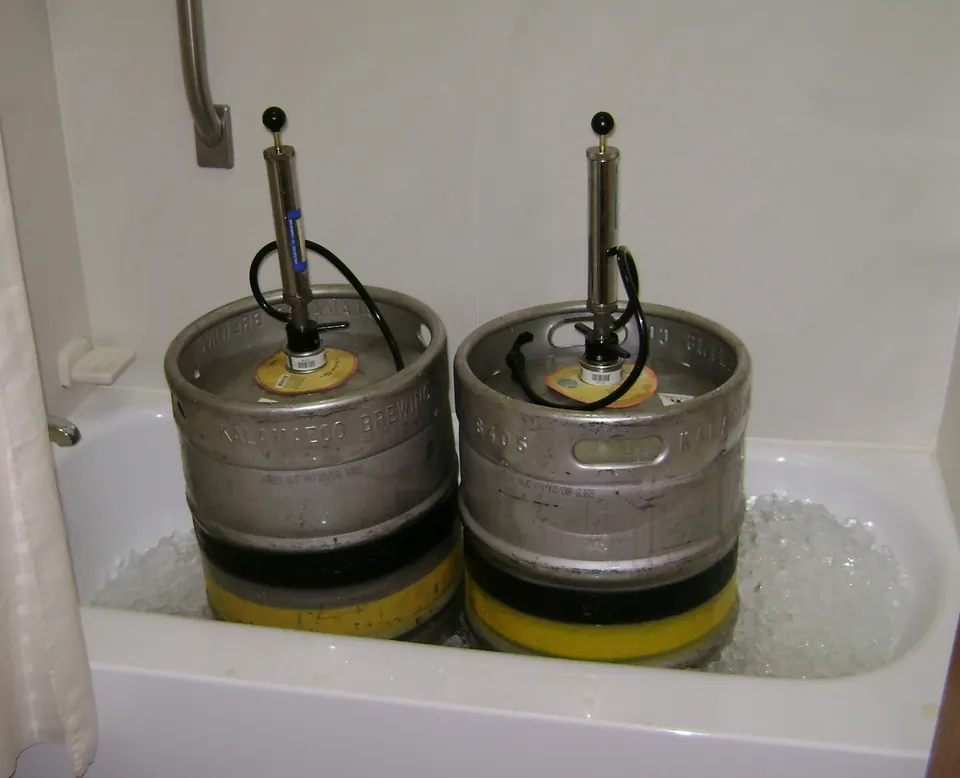
Two kegs with tap couplers chilling in a tub of ice
Photo: Douglas Muth from Ardmore, PA, USA, CC BY-SA 2.0, via Wikimedia Commons
Units
Gauges read relative to local air pressure: add about 0.5 psi per 1,000 ft.
Set the regulator to—

Keg pressure (psi, sea level) by beer temperature and target CO2 volumes

Beer temp1.8 vol2.0 vol2.2 vol2.4 vol2.6 vol2.8 vol3.0 vol3.2 vol
32°F 0°C1.63.55.47.39.211.012.914.8
34°F 1.1°C2.34.36.38.210.212.114.116.0
36°F 2.2°C3.15.17.29.211.213.315.317.3
38°F 3.3°C3.96.08.110.212.314.416.518.6
40°F 4.4°C4.76.89.011.213.415.517.719.8
42°F 5.6°C5.57.710.012.214.416.718.921.1
44°F 6.7°C6.38.610.913.215.517.820.122.4
46°F 7.8°C7.19.511.814.216.619.021.323.7
48°F 8.9°C7.910.412.815.317.720.122.625.0
50°F 10°C8.711.313.816.318.821.323.826.3
52°F 11.1°C9.612.214.817.319.922.525.127.6
54°F 12.2°C10.413.115.718.421.123.726.329.0
56°F 13.3°C11.314.016.719.522.224.927.630.3

Formula: PSI = −16.6999 − 0.0101059·T + 0.00116512·T² + 0.173354·T·V + 4.24267·V − 0.0684226·V². Checked against the BYO grid (40°F and 2.4 vol: 11.19 psi by formula, 11.2 psi on the chart). Regulator gauges read relative to local air pressure. BYO notes that Denver needs about 3 psi over the sea-level chart; add roughly 0.5 psi per 1,000 ft. Sources: BYO: Carbonation priming chart; Brewer's Friend: Force carbonation chart; Brewers Association: Draught Beer Quality Manual.

Runs in your browser; nothing is sent anywhere.
CO2 cylinders and pressureKeep cylinders upright and secured, and always use a CO2-rated regulator (US CO2 tanks use the CGA 320 valve fitting); never connect a cylinder straight to a keg. Store tanks cool and away from heat. CO2 displaces oxygen and collects low: ventilate, close the tank valve and leave the room if a tank leaks. Never exceed a fermenter’s or keg’s rated pressure.Source: Kegco: Everything you need to know about CO2; OSHA hazard bulletin on CO2

How it’s calculated

  1. PSI = −16.6999 − 0.0101059·T + 0.00116512·T² + 0.173354·T·V + 4.24267·V − 0.0684226·V² (T °F, V volumes)
  2. Altitude: add about 0.5 psi per 1,000 ft

Assumptions

  • Gauge pressure at sea level; beer held at the chart temperature until it reaches equilibrium (often 1–2 weeks at serving pressure).
  • Checked against the BYO grid: 40°F and 2.4 vol → 11.19 psi by formula, 11.2 psi on the chart.

Worked example: 38°F and 2.5 volumes → about 11.2 psi; at 5,000 ft add about 2.5 psi.

Sources: BYO: Carbonation priming chart (force carbonation grid); Brewers Association: Draught Beer Quality Manual

For guidance only: verify with your own readings, your equipment’s manual and the product labels.

How long does force carbonation take?

At serving pressure (set-and-forget) most kegs reach the chart's carbonation in one to two weeks. Higher-pressure shortcuts work faster but overshoot easily; drop back to the chart pressure afterwards.

Serving pressure is not the whole story

Line length and diameter set how fast beer pours. If the pour is foamy at the right carbonation, balance the line (see the Draught Beer Quality Manual) rather than turning the pressure down, which slowly flattens the beer.

Questions

What PSI should my keg be at?
About 10–12 psi at 38–40°F gives roughly 2.4–2.5 volumes (2.4 vol: about 10.2 psi at 38°F, 11.2 psi at 40°F), typical for American ales. Use the chart for your exact temperature.
Do I need to adjust for altitude?
Yes, add about 0.5 psi per 1,000 ft. At 5,000 ft that is about 2.5 psi over the chart.
Is it safe to raise the pressure?
Never exceed the keg's or fermenter's rated pressure, keep the cylinder upright and chained, and always use a regulator with a pressure relief.

Sources

  1. BYO: Carbonation priming chart
  2. Brewers Association: Draught Beer Quality Manual