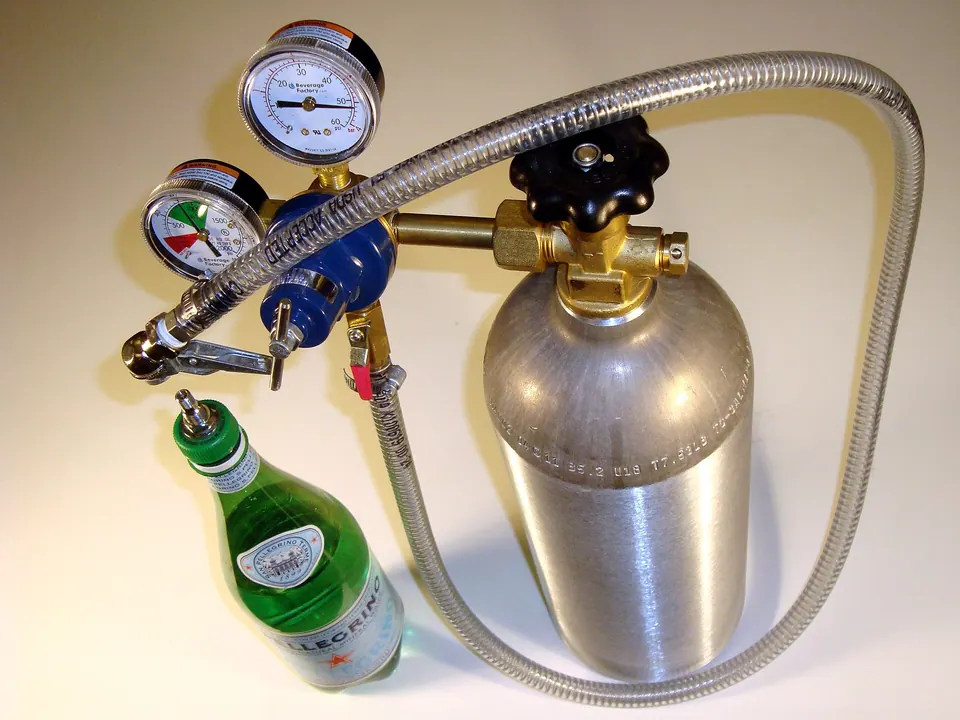
- The best CO2 regulator for most kegerators is a dual-gauge primary with a check valve and a working range to about 60 psi; the Taprite dual gauge with MFL check valve is our pick.
- Two beers at different carbonation need two pressures: a dual-body regulator (Taprite T752HP, Kegco Elite dual body) or a secondary.
- Listed relief points run about 55–65 psi. That is above a FermZilla’s 2.4–2.5 bar (35–36 psi), so a fermenter needs its own relief valve.
- Use a regulator made for CO2 (CGA320 inlet). Never use a nitrogen or oxygen regulator on a CO2 cylinder, or the reverse.
The best CO2 regulator turns the high pressure inside a CO2 cylinder into a steady, adjustable low pressure for your kegs. The low-pressure gauge shows what goes to the keg; the high-pressure gauge shows what’s left in the tank (roughly; CO2 stays liquid, so the tank gauge only drops near empty). A check valve stops beer from backing up into the regulator, and a relief valve vents if something fails.
We compared nine regulators from six brands: Taprite, Kegco, KOMOS, VEVOR, TMCRAFT and KegLand. Ranges and relief points are exactly as listed; where a listing gives no relief point, we say not listed.
Our picks
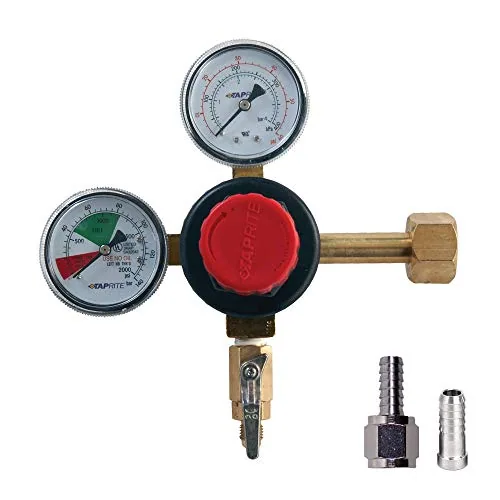
Taprite Dual Gauge CO2 Regulator with MFL Check Valve
Taprite
- Couplers
- MFL check valve; 1/4 and 5/16 in. barbs
- Gauges
- Dual gauge
- Pressure
- Safety blow-off at 55–60 PSI
Taprite’s dual-gauge regulator with an MFL check valve is assembled and tested in the USA, has a safety blow-off at 55–60 PSI and comes with 1/4 and 5/16 in. barbs plus a swivel nut, so it fits most gas line sizes out of the box.
Best for: One or more kegs at the same pressure
Skip if: You need two beers at different pressures
- Check valve
- 55–60 PSI blow-off
- Two barb sizes included
- Working range not printed on this listing
- Single pressure output
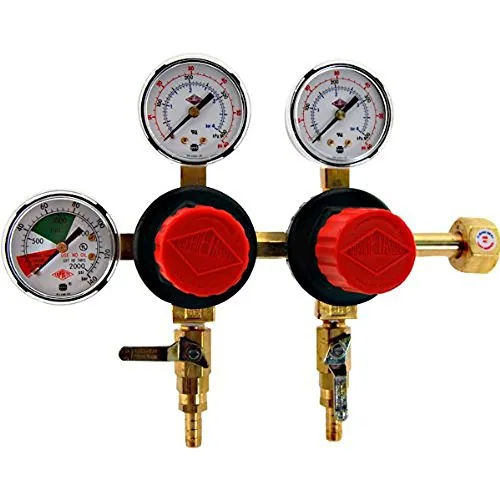
Taprite T752HP Two-Product Dual Pressure Regulator
Taprite
- Couplers
- 5/16 in. barbs, check valves
- Gauges
- Two-product dual pressure
- Pressure
- Blow-off 55–65 psig
The Taprite T752HP has two regulator bodies on one inlet, so you can serve a lager and a stout at different pressures from one tank. Each body has a sentry shut-down safety, a shut-off with back-flow check valve and a 5/16 in. barb; blow-off is factory set at 55–65 psig, and a quad-ring inlet seal replaces the fiber washer.
Best for: Two-tap kegerators with different beers
Skip if: Your beers share one carbonation level
- Two independent pressures
- Check valves on both outlets
- No washer needed at tank changes
- Working range not printed on this listing
- Two outputs only
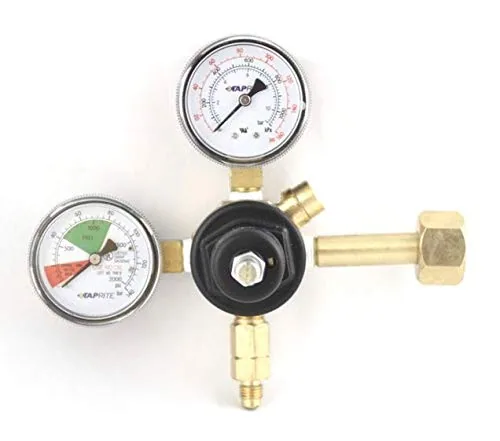
Taprite Primary Dual Gauge Regulator, 0–120 PSI
Taprite
- Couplers
- CGA320 inlet, 1/4 in. MFL outlet with check
- Gauges
- Working 0–120 PSI, tank 0–2000 PSI
- Type
- CO2 regulator
This Taprite primary has a solid brass body, a 0–120 PSI working range, a 0–2000 PSI tank gauge, a CGA320 inlet and a 1/4 in. MFL outlet with a check valve. The extra range helps with high-carbonation styles and fast carbonation in kegs.
Best for: Highly carbonated beers and burst carbonation in kegs
Skip if: You also push gas into a PET fermenter; the range far exceeds its rating
- 0–120 PSI working range
- MFL outlet with check
- Brass body
- Easy to overshoot low settings
- Relief point not listed
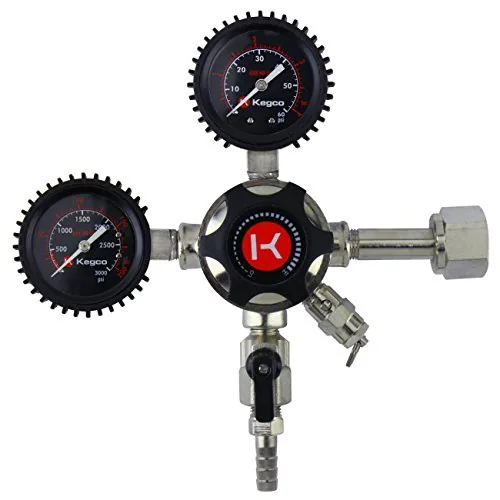
Kegco Elite Series Dual Gauge CO2 Regulator, 1 Product
Kegco
- Gauges
- Dual gauge with rubber boots
- Type
- CO2 regulator
- Pressure
- Adjustable 0–60 PSI
Kegco’s Elite Series single-product regulator has booted dual gauges with high-contrast markings and a large handle for adjustment between 0 and 60 PSI.
Best for: Brewers who want clear gauges and a big knob
Skip if: You need a listed check valve
- 0–60 PSI
- Rubber gauge boots
- Large adjuster
- Check valve and relief point not listed on this listing
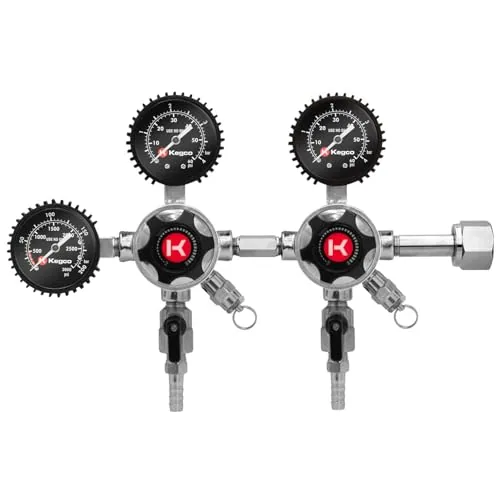
Kegco Elite Series Dual Body CO2 Regulator
Kegco
- Gauges
- Dual body, two products
- Type
- CO2 regulator
- Pressure
- Adjustable 0–60 PSI
Kegco’s Elite dual-body regulator serves two kegs at different pressures from one tank, adjustable 0–60 PSI, in chrome-plated brass with manual release valves, internal relief valves at 55–65 PSI, a built-in tank washer and a sintered filter in the stem.
Best for: Two beers at two pressures
Skip if: You only run one pressure
- Two pressures
- 55–65 PSI relief
- Sintered inlet filter
- Two outputs only
- Bulkier than a single body
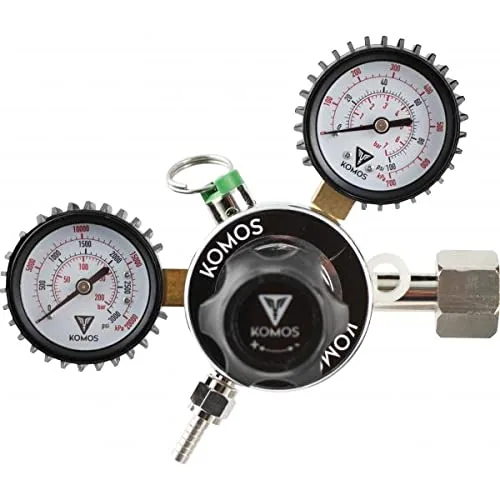
KOMOS Dual Gauge CO2 Regulator, 0–60 PSI, Duotight Adapter
KOMOS
- Couplers
- 1/4 in. flare + Duotight adapter
- Gauges
- Dual gauge
- Pressure
- 0–60 PSI, 65 psi PRV
KOMOS lists a 0–60 PSI dual-gauge regulator with a 1/4 in. flare and barbed outlet, a 65 psi PRV and an included Duotight adapter for EVABarrier tubing, made in accordance with AS 4267.
Best for: Duotight push-in fittings and EVABarrier line
Skip if: Your system uses only barbs and clamps
- 65 psi PRV
- Duotight adapter included
- Standard listed (AS 4267)
- Check valve not listed
- Single output
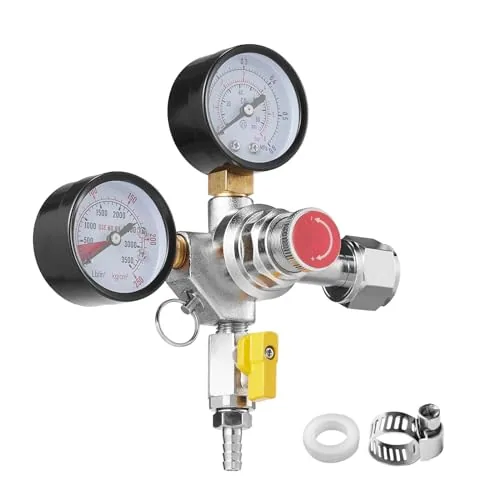
VEVOR Double Gauge CO2 Regulator, 0–60 PSI, CGA320
VEVOR
- Couplers
- CGA320, check valve
- Gauges
- Double gauge
- Pressure
- 0–60 PSI; relief at 65 PSI
VEVOR’s CGA320 double-gauge regulator adjusts from 0 to 60 PSI, has a check valve and a relief that opens at 65 PSI, and ships with gaskets and clamps.
Best for: A first regulator for one pressure
Skip if: You want US assembly or a two-pressure body
- 0–60 PSI
- 65 PSI relief
- Check valve
- 8 mm hose sizing stated; check your lines
- Single output
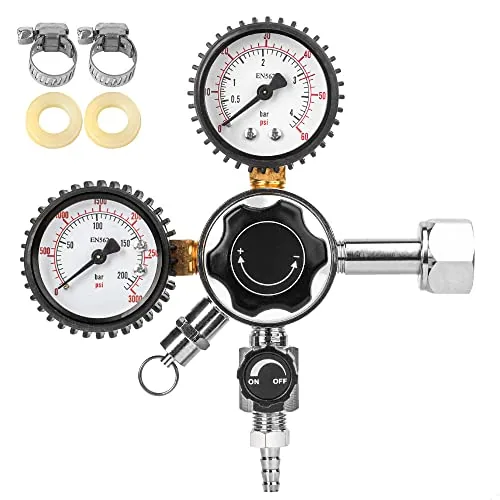
TMCRAFT Dual Gauge CO2 Regulator, CGA-320
TMCRAFT
- Couplers
- CGA-320
- Gauges
- Working 0–60 psi, tank 0–3000 psi
- Pressure
- Safety relief valve
TMCRAFT’s forged-brass regulator shows 0–60 psi working and 0–3000 psi tank pressure on booted gauges, with a CGA-320 inlet, a pressure relief valve and an anti-backflow seal.
Best for: A spare or second regulator
Skip if: You want the relief point printed
- Forged brass
- Booted gauges
- CGA-320 inlet
- Relief point not listed
- Single output
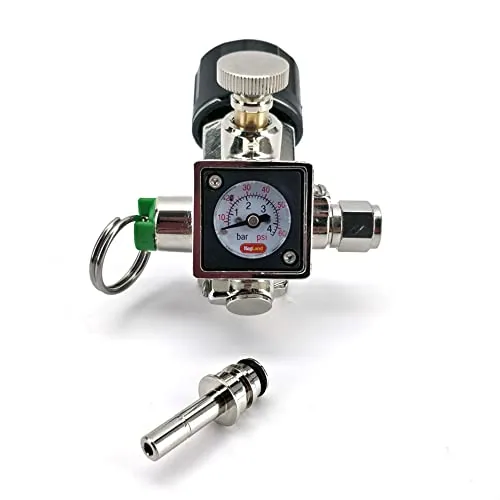
KegLand Mini Core CO2 Regulator
KegLand
- Couplers
- 16 g 3/8 in.-24 UNF cartridges; TR21-4 soda cylinders
- Gauges
- Mini regulator
- Type
- CO2 regulator
KegLand’s Mini Core regulator takes 16 g 3/8 in.-24 UNF threaded cartridges or US/EU TR21-4 soda gas cylinders, for mini kegs, picnics and topping up a keg away from the kegerator.
Best for: Mini kegs and portable serving
Skip if: You run a kegerator off a 5 lb tank
- Cartridges or soda cylinders
- Very compact
- Portable
- Range and relief not listed
- Small cartridges empty fast
What relief point does each CO2 regulator list?
Every primary regulator here vents somewhere between about 45 and 65 psi when its relief is listed. That protects kegs (130 PSI operating on new corny kegs) and your lines, but it does not protect a PET fermenter rated at 35–36 psi. If you push CO2 into a fermenter, the vessel needs its own relief valve and you must keep the regulator set below the vessel rating.
Listed relief or blow-off point vs a FermZilla rating
psi; upper end of each listed range. The LUCKEG kit (45 psi) is in our keg system guide.
Regulators compared by listed specs
| Regulator | Outputs | Working range | Relief / blow-off | Check valve |
|---|---|---|---|---|
| Taprite dual gauge, MFL check | 1 | Not printed | 55–60 PSI | ✓ |
| Taprite T752HP | 2 | Not printed | 55–65 psig | ✓ Both outlets |
| Taprite primary 0–120 | 1 | 0–120 PSI | Not listed | ✓ MFL with check |
| Kegco Elite single | 1 | 0–60 PSI | Not listed | Not listed |
| Kegco Elite dual body | 2 | 0–60 PSI | 55–65 PSI | Not listed |
| KOMOS dual gauge | 1 | 0–60 PSI | 65 psi PRV | Not listed |
| VEVOR double gauge | 1 | 0–60 PSI | 65 PSI | ✓ |
| TMCRAFT dual gauge | 1 | 0–60 psi | Relief valve (point not listed) | ~ Anti-backflow seal |
| KegLand Mini Core | 1 | Not listed | Not listed | Not listed |
Source: Maker listings, November 2026
Primary, dual-body or secondary?
A primary regulator screws onto the cylinder and sets one pressure. A dual-body regulator puts two adjustable bodies on one primary inlet, for two pressures. A secondary regulator sits downstream of a primary and adds more pressures for a keezer; Kegco notes its secondary still needs a primary feeding it through a gas line. A gas manifold splits one pressure to several kegs without changing it. Start with a primary; add a secondary only when you need a third or fourth carbonation level.
What pressure should you set on the regulator?
Set the regulator from the carbonation chart, not by the foam in the glass. Find your kegerator temperature and target volumes; at 40°F, 2.4 volumes is about 11.2 psi by the BYO-checked formula. Add about 0.5 psi per 1,000 ft of altitude, or use the keg carbonation calculator.
Keg pressure (psi, sea level) by beer temperature and target CO2 volumes
| Beer temp | 1.8 vol | 2.0 vol | 2.2 vol | 2.4 vol | 2.6 vol | 2.8 vol | 3.0 vol | 3.2 vol |
|---|---|---|---|---|---|---|---|---|
| 32°F 0°C | 1.6 | 3.5 | 5.4 | 7.3 | 9.2 | 11.0 | 12.9 | 14.8 |
| 34°F 1.1°C | 2.3 | 4.3 | 6.3 | 8.2 | 10.2 | 12.1 | 14.1 | 16.0 |
| 36°F 2.2°C | 3.1 | 5.1 | 7.2 | 9.2 | 11.2 | 13.3 | 15.3 | 17.3 |
| 38°F 3.3°C | 3.9 | 6.0 | 8.1 | 10.2 | 12.3 | 14.4 | 16.5 | 18.6 |
| 40°F 4.4°C | 4.7 | 6.8 | 9.0 | 11.2 | 13.4 | 15.5 | 17.7 | 19.8 |
| 42°F 5.6°C | 5.5 | 7.7 | 10.0 | 12.2 | 14.4 | 16.7 | 18.9 | 21.1 |
| 44°F 6.7°C | 6.3 | 8.6 | 10.9 | 13.2 | 15.5 | 17.8 | 20.1 | 22.4 |
| 46°F 7.8°C | 7.1 | 9.5 | 11.8 | 14.2 | 16.6 | 19.0 | 21.3 | 23.7 |
| 48°F 8.9°C | 7.9 | 10.4 | 12.8 | 15.3 | 17.7 | 20.1 | 22.6 | 25.0 |
| 50°F 10°C | 8.7 | 11.3 | 13.8 | 16.3 | 18.8 | 21.3 | 23.8 | 26.3 |
| 52°F 11.1°C | 9.6 | 12.2 | 14.8 | 17.3 | 19.9 | 22.5 | 25.1 | 27.6 |
| 54°F 12.2°C | 10.4 | 13.1 | 15.7 | 18.4 | 21.1 | 23.7 | 26.3 | 29.0 |
| 56°F 13.3°C | 11.3 | 14.0 | 16.7 | 19.5 | 22.2 | 24.9 | 27.6 | 30.3 |
Formula: PSI = −16.6999 − 0.0101059·T + 0.00116512·T² + 0.173354·T·V + 4.24267·V − 0.0684226·V². Checked against the BYO grid (40°F and 2.4 vol: 11.19 psi by formula, 11.2 psi on the chart). Regulator gauges read relative to local air pressure. BYO notes that Denver needs about 3 psi over the sea-level chart; add roughly 0.5 psi per 1,000 ft. Sources: BYO: Carbonation priming chart; Brewer's Friend: Force carbonation chart; Brewers Association: Draught Beer Quality Manual.
Use a regulator built for CO2: the CGA320 inlet is the CO2 standard on these listings; nitrogen uses a different valve (CGA580). Fit the washer or seal every tank change, open the cylinder valve slowly, leak-check with soapy water, and keep a CO2 monitor near kegerators in small rooms. Cylinders carry a stamped test date; ask your fill shop whether yours is in date.
Source: Kegco: Everything you need to know about CO2How to install a CO2 regulator in 6 steps
- Secure the cylinder upright
Strap or bracket the cylinder so it can’t tip. Inside a kegerator, keep it clear of the door.
- Fit the washer and regulator
Thread the regulator onto the CGA320 valve with a new washer (or the quad-ring on the T752HP) and tighten with a wrench.
- Back the adjuster out
Turn the adjustment knob counterclockwise so the output starts near zero, and close the shut-off.
- Open the cylinder slowly
Open the tank valve fully and slowly; the high-pressure gauge rises.
- Set pressure and check leaks
Raise the output to your chart pressure, open the shut-off and spray every joint with soapy water. Bubbles mean a leak.
- Log the setting
Note the pressure, temperature and date in the brew-day log so you can repeat it.
Regulator mistakes to avoid
- Reading the tank gauge as a fuel gauge. It stays high until the liquid CO2 is gone, then drops fast.
- No check valve. Beer can back up into the regulator if the keg is at higher pressure.
- One pressure for every beer. A dual-body regulator lets a stout and a wheat beer sit at different levels.
- Pushing gas into a fermenter at keg pressure. Stay below the vessel rating; see our pressure fermenter picks.
- Laying the cylinder down. Keep it upright so liquid CO2 doesn’t reach the regulator.
Who should pick which CO2 regulator?
| If you… | Pick |
|---|---|
| Want one reliable regulator for a kegerator | Taprite dual gauge with MFL check valve |
| Serve two beers at different pressures | Taprite T752HP or Kegco Elite dual body |
| Burst-carbonate or serve high-carbonation styles | Taprite primary 0–120 PSI |
| Use Duotight and EVABarrier lines | KOMOS dual gauge |
| Want a low-cost first regulator | VEVOR or TMCRAFT |
| Serve from mini kegs or on the go | KegLand Mini Core |
| Want clear gauges and a big knob | Kegco Elite single |
Building the rest of the system? See our homebrew keg systems and kegerators, plan costs in the budget builder, and browse kegging and draft or switching to kegs.
The Taprite dual gauge with MFL check valve is the best CO2 regulator for a first kegerator. Choose the Taprite T752HP or Kegco Elite dual body for two pressures, the Taprite 0–120 for high-carbonation beers in kegs, and the KOMOS if you run Duotight fittings. Keep any fermenter on its own relief valve.
Before you buy, read how to keg homebrew and force carbonate and brew-day safety: propane, CO2, glass and chemicals.
We compared outputs, working ranges, relief or blow-off points, check valves, inlet type and included fittings from maker listings and manuals, and used BYO’s carbonation grid and published CO2 safety guidance from Kegco and Grainfather. We did not install or bench-test these regulators. No scores, ratings or prices.