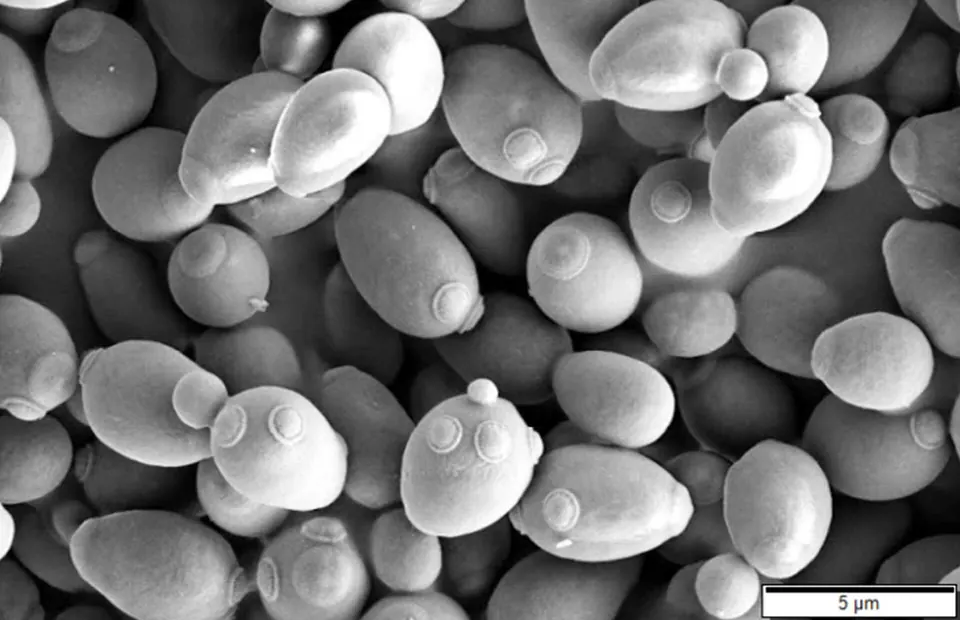
- Mead and many fruit wines are low in nitrogen; beer wort and grape juice usually aren't. Nutrient matters most for honey and non-grape musts.
- Go-Ferm goes in the yeast's rehydration water; Fermaid K and Fermaid O go in the must, in steps. Lallemand lists Fermaid K at 12.5 g/hL at the end of the lag phase plus 12.5 g/hL at 1/3 sugar depletion.
- Fermaid O is organic nitrogen with no DAP; Fermaid K blends DAP with organic nitrogen and micronutrients; the Craft A Brew nutrient is DAP plus urea.
- Beer nutrients from Wyeast and White Labs (Servomyces) are boil additions for strong or high-adjunct worts. Use every product per its label.
The best yeast nutrient depends on what you ferment. A honey must for mead is short on the nitrogen and micronutrients yeast need, so it can stall or throw sulfur smells. Fruit wines and hard seltzer bases are similar. Malt wort and grape juice usually carry enough, though very strong or sugar-heavy batches benefit from help.
This list compares ten nutrients from six brands by what they contain and the dose on the label or listing. Four are Lallemand products (two Go-Ferm packs, Fermaid K and Fermaid O) repacked by different sellers; the rest cover general nutrients, an energizer and beer-specific blends. Where a listing gives no dose, we say "per the label" and leave it there.
Our picks
Lallemand Fermaid O Yeast Nutrient, 3.5 oz
Lallemand (LalBrew)
- Type
- Organic nitrogen nutrient (no DAP)
- Size
- 3.5 oz
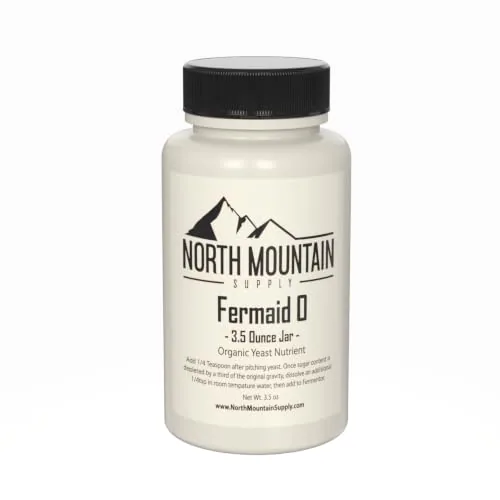
Fermaid O is Lallemand's organic nitrogen nutrient with no DAP, here in a 3.5 oz jar repacked by North Mountain Supply. The listing says it lowers peak fermentation temperatures and improves late-fermentation kinetics, with fewer sulfur off-odors such as H2S. Suspend it in water or must before adding, so the CO2 release doesn't foam the vessel over.
Best for: Traditional and fruit meads with stepped nutrient additions
Skip if: You want a one-scoop nutrient with the dose printed on the listing
- Organic nitrogen, no DAP
- Fewer sulfur off-odors per maker
- Mixing directions on the listing
- Dose not on this listing
- Foams if added dry to fermenting must
Lallemand Fermaid K Yeast Nutrient, 2 oz
Lallemand (LalBrew)
- Type
- Blended nutrient (DAP + organic nitrogen + micronutrients)
- Dose
- 12.5 g/hL at end of lag + 12.5 g/hL at 1/3 sugar depletion
- Size
- 2 oz (56.7 g)
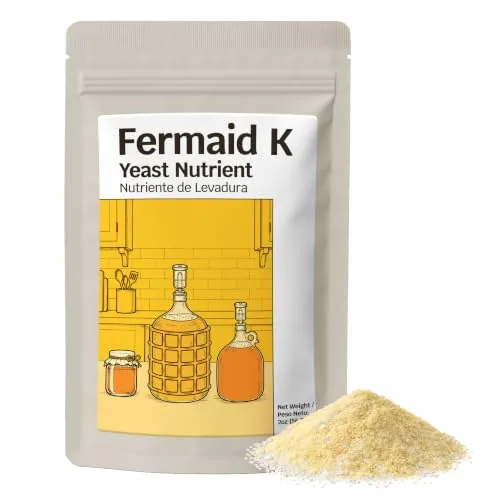
Fermaid K blends DAP (inorganic nitrogen), alpha amino nitrogen, magnesium sulfate, thiamine, folic acid, niacin, biotin, calcium pantothenate and inactivated yeast, with no urea. The listing gives Lallemand's two-step dose: 12.5 g/hL at the end of the lag phase and 12.5 g/hL after 1/3 sugar depletion.
Best for: Grape and fruit wines, and ciders from juice
Skip if: You want an all-organic nutrient plan
- Two-step dose published
- Nitrogen plus micronutrients
- No urea per listing
- Contains DAP: don't add late
- Small 2 oz pack
Lallemand Go-Ferm Protect Evolution, 100 g
Lallemand (LalBrew)
- Type
- Yeast rehydration nutrient
- Dose
- 30 g/hL with Lalvin yeast (per Lallemand)
- Size
- 100 g
Go-Ferm Protect Evolution, repacked by CellarScience, is the rehydration nutrient Lallemand pairs with EC-1118 at 30 g/hL. Mix it into warm rehydration water before the yeast goes in. It is not a must nutrient, and DAP never goes into the Go-Ferm water.
Best for: High-gravity meads and wines started with dry wine yeast
Skip if: You direct-pitch beer yeast into wort
- 30 g/hL with Lalvin yeast per Lallemand
- 100 g pack covers many batches
- Only for rehydration water
- Thin listing; follow Lallemand's sheet
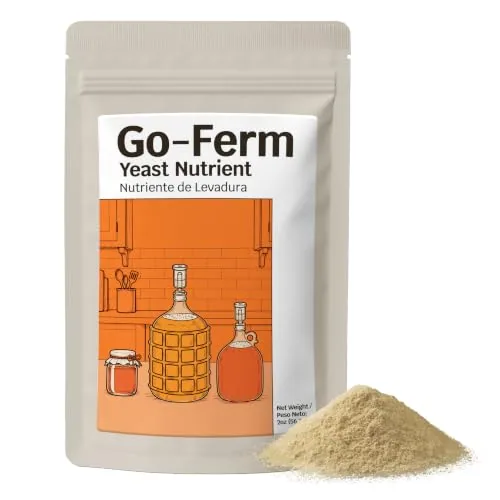
Lallemand Go-Ferm Rehydration Nutrient, 2 oz
Lallemand (LalBrew)
- Type
- Yeast rehydration nutrient
- Size
- 2 oz (56.7 g)
The original Go-Ferm, 2 oz (56.7 g), is described by the maker as a yeast-derived product made by autolysis, rich in micronutrients such as magnesium and zinc, delivered while the yeast rehydrates. The listing says yeast viability increases and fermentations finish stronger; those are maker claims.
Best for: Occasional meads and wines
Skip if: You already own Go-Ferm Protect Evolution
- Small 2 oz pack
- Clear description of how it works
- Dose not on this listing
- Rehydration use only
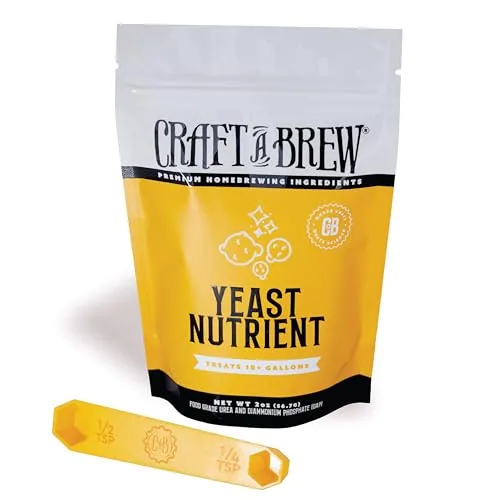
Craft A Brew Yeast Nutrient (DAP + urea), 2 oz
Craft A Brew
- Type
- Yeast nutrient (urea and DAP)
- Dose
- 1 tsp per gallon
- Size
- 2 oz
Craft A Brew's nutrient is a blend of food-grade urea and diammonium phosphate (DAP). The label says 1 teaspoon per gallon, added at the start of fermentation, and recommends it for musts that aren't nutrient-dense: non-grape wines, meads and hard seltzers. It notes that malt and grapes usually don't need it.
Best for: 1-gallon meads, fruit wines and seltzers
Skip if: You prefer organic nitrogen (choose Fermaid O)
- 1 tsp per gallon
- Clear when-to-use guidance
- Food grade per maker
- Single addition at the start only
- Inorganic nitrogen sources only
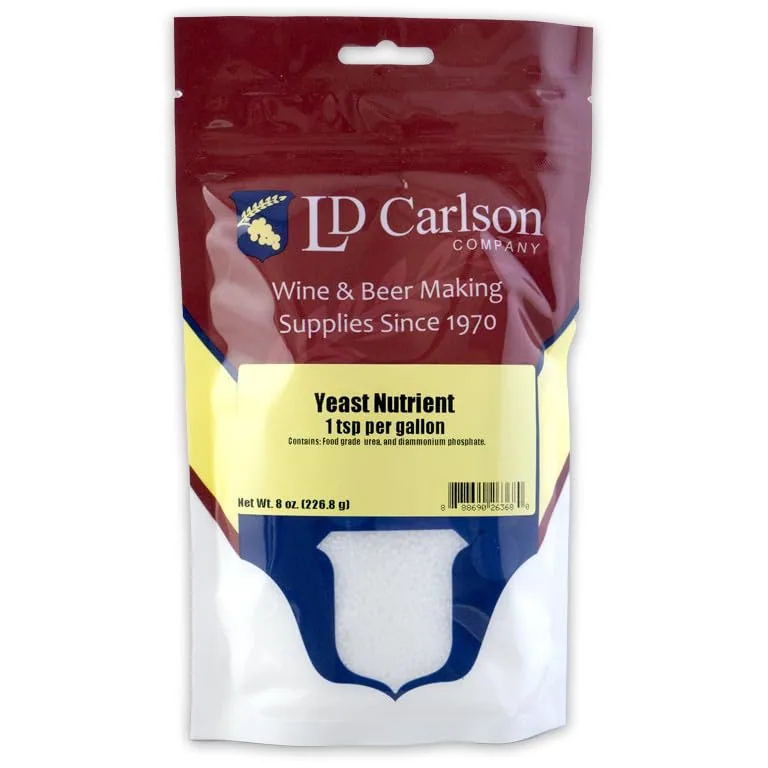
LD Carlson Yeast Nutrient
LD Carlson
- Type
- Yeast nutrient
- Dose
- 1 tsp per gallon (listing)
- Size
- 2 oz (title) / 8 oz (attrs)
LD Carlson's yeast nutrient lists a typical rate of 1 teaspoon per gallon for high-sugar fermentations, to help avoid sluggish or stalled ferments. The title says 2 oz while the size field says 8 oz, so check what arrives. Composition isn't listed.
Best for: Fruit wines and country wines
Skip if: You want to know exactly what's in the jar
- 1 tsp per gallon
- Widely used general nutrient
- Composition not listed
- Pack size unclear (2 oz vs 8 oz)
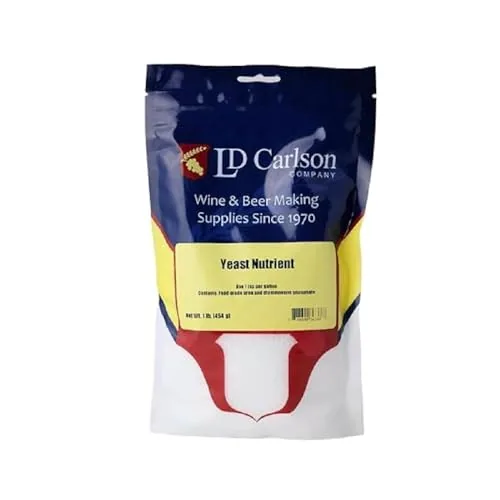
LD Carlson Fermax Yeast Nutrient, 1 lb
LD Carlson
- Type
- Yeast nutrient (proteins, amino acids, vitamins)
- Size
- 1 lb
LD Carlson Fermax is a 1 lb blend of proteins, amino acids and vitamins sold to improve attenuation and fermentation speed (maker claims). The listing gives no dose, so follow the package.
Best for: Frequent wine and mead makers
Skip if: You make one batch a year
- 1 lb bulk size
- Proteins, amino acids and vitamins
- Dose not listed
- Packaging may vary per listing
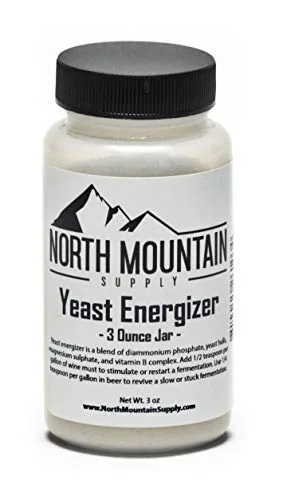
North Mountain Supply Yeast Energizer, 3 oz
North Mountain Supply
- Type
- Yeast energizer
- Dose
- 1.0–1.5 tsp per gallon
- Size
- 3 oz
North Mountain Supply's yeast energizer lists 1.0–1.5 teaspoons per gallon and says it is used to quicken or restart fermentation. Use it when a batch slows early, together with checking temperature and gravity, rather than as a routine addition.
Best for: Restarting a slow wine or mead
Skip if: Your fermentation is healthy
- 1.0–1.5 tsp per gallon
- Airtight jar
- Composition not listed
- Not a fix for cold or high-alcohol stalls
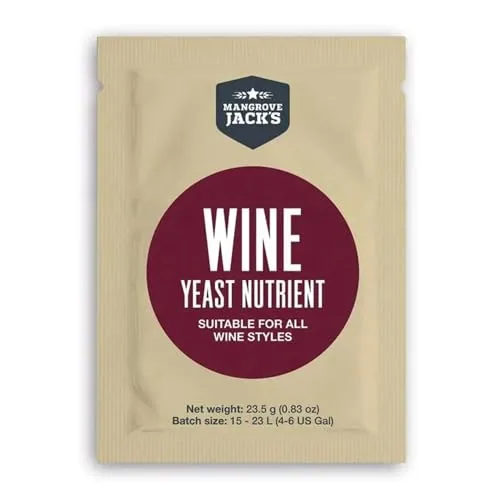
Mangrove Jack's Wine Yeast Nutrient
Mangrove Jack's
- Type
- Wine yeast nutrient
- Dose
- One sachet per 15–23 L (4–6 gal)
Mangrove Jack's wine nutrient comes as one sachet for 15–23 L (4–6 US gal) of grape or fruit juice must: dissolve, pitch the yeast and ferment. No measuring spoons involved.
Best for: 6-gallon fruit wines from juice
Skip if: You make 1-gallon batches (a sachet treats 4–6 gal)
- One sachet per batch
- Grape or fruit must
- Composition not listed
- Not sized for small batches
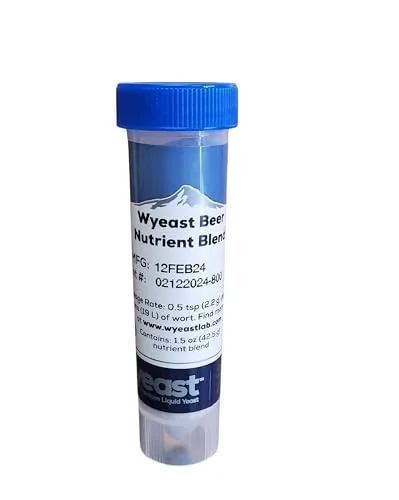
Wyeast Beer Yeast Nutrient, 1.5 oz
Wyeast
- Type
- Beer yeast nutrient
- Size
- 1.5 oz
Wyeast's yeast nutrient, 1.5 oz, is a beer-oriented blend that the maker says promotes yeast health and a cleaner fermentation profile. Add it in the boil per the label for strong worts and starters.
Best for: High-gravity beers and yeast starters
Skip if: You brew standard all-malt beers that ferment fine
- Beer-specific
- Small pack lasts many batches
- Dose not on this listing
- Composition not listed
Types of yeast nutrient compared
Nutrients fall into four groups. Rehydration nutrients (Go-Ferm) go in the water you wake dry yeast in. Organic nitrogen (Fermaid O) feeds yeast from inactivated-yeast sources. Complex blends (Fermaid K) mix DAP with organic nitrogen and vitamins. Simple inorganic nutrients (DAP, DAP plus urea) are cheap and quick. Energizers and beer nutrients sit alongside.
Yeast nutrients: type and label dose
| Product | Type | When | Dose (as listed) |
|---|---|---|---|
| Fermaid O | Organic nitrogen, no DAP | Stepped, during fermentation | Per the label |
| Fermaid K | DAP + organic N + micronutrients | End of lag + 1/3 sugar depletion | 12.5 g/hL + 12.5 g/hL |
| Go-Ferm Protect Evolution | Rehydration nutrient | In rehydration water | 30 g/hL with Lalvin yeast |
| Go-Ferm (2 oz) | Rehydration nutrient | In rehydration water | Not listed |
| Craft A Brew nutrient | DAP + urea | Start of fermentation | 1 tsp per gallon |
| LD Carlson Yeast Nutrient | Not listed | Start of fermentation | 1 tsp per gallon |
| LD Carlson Fermax | Proteins, amino acids, vitamins | Per the label | Not listed |
| NMS Yeast Energizer | Energizer | Slow or stuck ferments | 1.0–1.5 tsp per gallon |
| Mangrove Jack's wine nutrient | Not listed | Before pitching | 1 sachet per 4–6 gal |
| Wyeast nutrient | Beer nutrient blend | In the boil | Per the label |
| White Labs Servomyces | Zinc-enriched yeast | In the boil | Per the label |
Source: Product listings and Lallemand data, November 2026
Grams for a 5-gallon (19 L) batch at Lallemand's doses
0.19 hL × g/hL; Fermaid K shown as the total of both additions
For a 1-gallon batch, divide by about five: roughly 0.5 g of Fermaid K per addition. A 0.01 g pocket scale is the honest way to measure that; teaspoons are only as accurate as the powder's density.
Does your batch need nutrient?
- Mead: yes. Honey has little nitrogen. Published mead protocols such as TOSNA use organic nutrients in stepped additions; follow the protocol and your product labels.
- Fruit and country wines: usually yes, especially non-grape fruit.
- Hard seltzer: yes; a sugar-and-water base has almost nothing for yeast.
- Grape wine kits: usually not beyond what the kit includes; follow the kit.
- Cider from juice: often helpful; Fermaid K's schedule suits it.
- Beer: rarely for normal worts. Consider a beer nutrient for very strong worts, high-adjunct recipes and starters.
EC-1118 is a low-nitrogen-demand strain per Lallemand, which is one reason it's forgiving in meads, but Lallemand also notes it can produce SO2 up to 50 mg/L when nutrients run low. Feeding properly keeps sulfur smells down with any strain.
How to feed a mead or fruit wine step by step
- Rehydrate with Go-Ferm
Stir Go-Ferm into the warm rehydration water first, then add the dry wine yeast. For EC-1118, Lallemand gives 30 g/hL of Go-Ferm Protect Evolution and 95–104°F (35–40°C) water. No DAP in this water.
- Pitch into an aerated must
Temper the yeast to within 9–18°F (5–10°C) of the must, then pitch. Take an original gravity reading for your log.
- First addition at the end of the lag phase
When fermentation is visibly underway, add the first nutrient dose. For Fermaid K, that's 12.5 g/hL.
- Degas, then mix nutrient into a slurry
Stir gently to release CO2, then add nutrient suspended in a little water or must. Fermaid O's listing warns that dry powder can make the vessel foam over.
- Last addition by 1/3 sugar depletion
Fermaid K's second 12.5 g/hL dose goes in after about a third of the sugar is gone. Avoid late DAP additions after that point.
- Use energizer only if it slows early
If gravity stalls, check temperature first, then consider an energizer at its label rate.
- Log every addition
Record time, gravity and dose in the brew-day log; finish with the ABV calculator.
Mistakes to avoid
- Putting DAP in the rehydration water. Go-Ferm goes in the water; DAP and blends go in the must.
- Adding nutrient powder straight into fermenting must. It can erupt; suspend it in water first and degas.
- Feeding DAP late. Lallemand's Fermaid K schedule ends at about 1/3 sugar depletion; don't add DAP after that.
- Measuring grams by teaspoon. Weigh gram doses on a scale, especially for 1-gallon batches.
- Treating nutrient as a fix for cold. A stalled ferment in a 55°F garage needs warmth, not more powder.
- Off-label doses. More isn't better; stick to the label or the maker's published schedule.
Who should choose which nutrient?
Pick by batch
| You make… | Choose | Why |
|---|---|---|
| Traditional mead, 1–5 gal | Go-Ferm + Fermaid O | Rehydration nutrient plus organic nitrogen in steps |
| Wine or cider from juice | Fermaid K | Two-step dose published |
| A first 1-gallon mead or seltzer | Craft A Brew nutrient | 1 tsp per gallon, one addition |
| Fruit wine, 6 gal | Mangrove Jack's wine nutrient | One sachet per 4–6 gal |
| A ferment that slowed early | NMS energizer | 1.0–1.5 tsp per gallon to restart |
| Strong beer or a starter | Wyeast nutrient or Servomyces | Boil addition per label |
Browse every nutrient and strain in yeast and nutrients, kits in wine, cider, mead and kombucha, or start from beyond beer. Match nutrients to the best wine yeast for your must, see the mead kit picks, or, for beer, the best dry yeast for IPA.
For mead, the pairing to beat is Go-Ferm in the rehydration water and Fermaid O in stepped additions. For wine and cider from juice, Fermaid K has the clearest published schedule: 12.5 g/hL at the end of the lag phase and 12.5 g/hL at 1/3 sugar depletion. If you want one scoop for a 1-gallon batch, the Craft A Brew DAP-and-urea nutrient lists 1 teaspoon per gallon. Beer rarely needs any; keep Wyeast nutrient or Servomyces for strong worts and starters.
Before you buy, read how to make mead and how to make hard seltzer at home.
We compared listings and Lallemand's published data for each nutrient's type (organic, inorganic or blended), what it contains, when it goes in and the dose. Where a listing gives no dose or composition, we say so rather than borrow one. We did not ferment with these products. Mead nutrient protocols vary; we name TOSNA without quoting its numbers, which you should take from the protocol itself. No scores or prices.